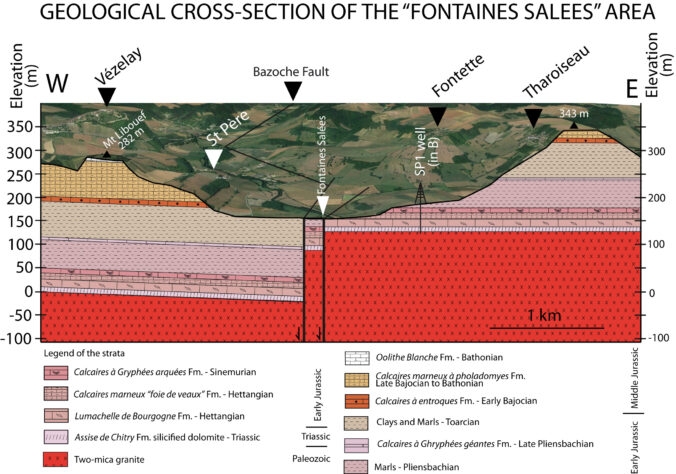
To better understand the origin of helium and nitrogen degassing along the border of a large sedimentary basin (the Paris Basin), we conducted a combined geological, geophysical and geochemical study at the archaeological site of Fontaines Salées in Saint-Père-sous-Vézelay, in the Morvan region (France).
One of the major findings was the identification, through electrical tomography, of a gas-rich zone in the aquifer, located 20 meters deep at the interface between the granitic basement and the sedimentary cover.
Directly above this zone, gas analysis from soil and from bubbling wells reveals a composition dominated by nitrogen, with an exceptionally high helium content (up to 6%). This helium is enriched in radiogenic ⁴He, indicating that it is likely produced in the granite by alpha decay of radioactive elements (U, Th) present in minerals such as zircon or apatite.
A geochemical model is proposed to explain this signature, based on the exsolution of dissolved nitrogen during paleo-recharges by meteoric water. As this water infiltrates several kilometers deep into the granite, it mixes with helium-enriched groundwater. It then rises toward the basement-cover interface and eventually to the surface through fault zones, particularly where the caprock is not present.
Congratulations to Emmanuel Léger for leading this study and coordinating the entire team! @GEOPS @université Paris-Saclay @45-8 @Université de Pau @Université d’Orléans @University of Glasgow
Link https://agupubs.onlinelibrary.wiley.com/doi/10.1029/2024GC012021


 orcid.org/0000-0001-6961-2177